Artistic Scripts Under Police Scrutiny: Regulation or Censorship?
15 July 2026
Art is both an ancient and a modern instrument, playing a central role in the informal politics of every country. In the Kurdistan Region, however, its already wounded body is repeatedly subjected to new cuts, while those working in the sector are driven further into frustration.
“Security agencies are looking for excuses to inspect our scripts,” one theatre director said. Another added: “The frustration has become so severe that artists have lost the energy to produce theatre, while audiences have lost the desire to watch it.”
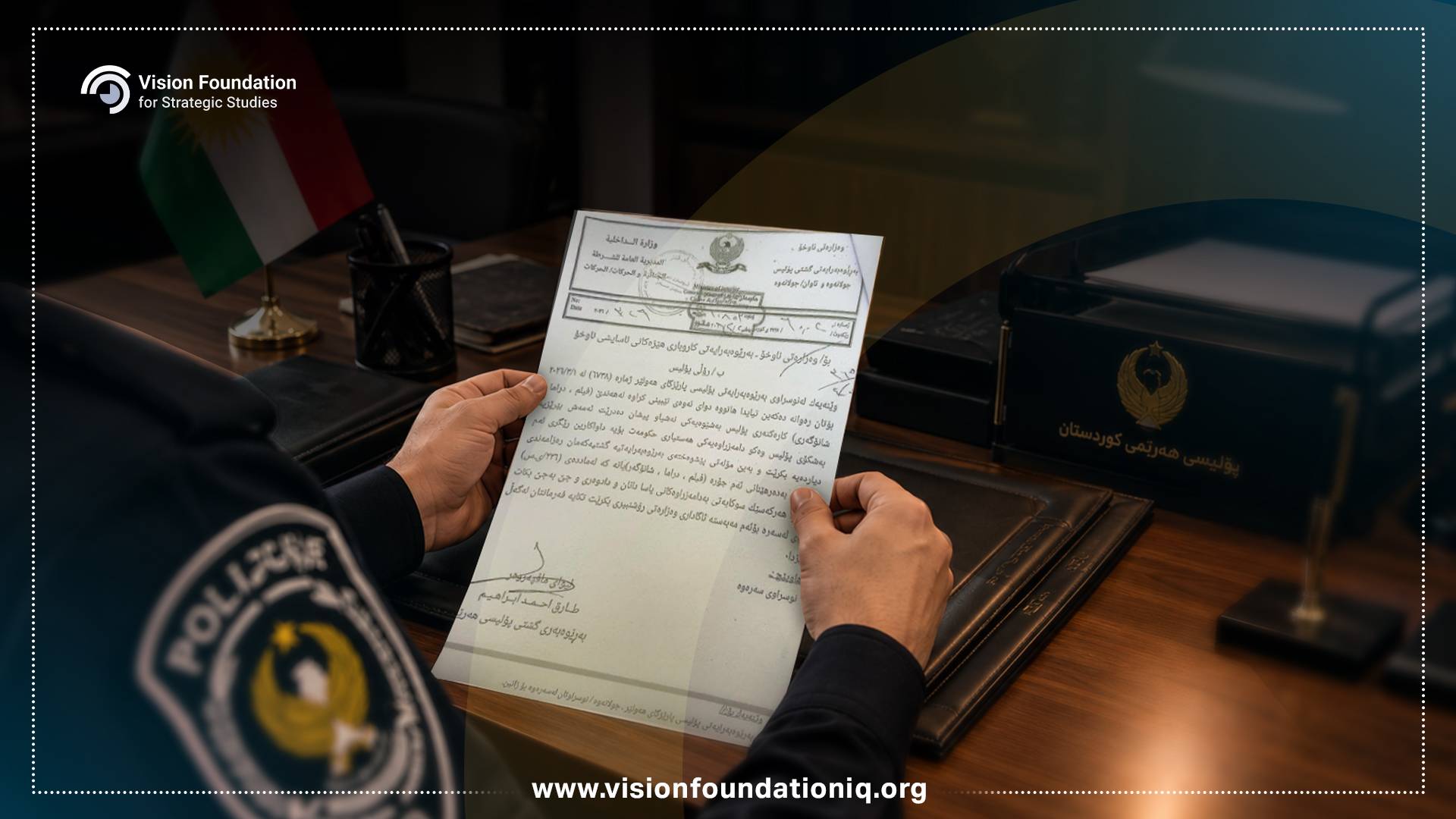
Against this backdrop, a request by the General Directorate of Police of the Kurdistan Region has become the subject of heated debate. The directorate has asked the Ministry of Interior to require police review of theatre, drama and film scripts and to prevent their production or screening without prior police approval.
The move has alarmed and surprised artists, who fear that it could pose a serious threat to artistic work. Many describe it as a form of “censorship” reminiscent of practices used in previous centuries.
The Decision Threatens the Future of Artistic Work
The Vision Foundation for Strategic Studies investigated the issue. Artists view the measure as a serious threat, while the responsible authorities describe it as an ordinary and lawful procedure.
Mahdi Hassan, a theatre director from Erbil, attributed the police decision to what he described as irresponsible behavior by some artists.
“During Ramadan, several artists produced a television drama containing extensive insults against the police,” Hassan said. “That production led to the issuance of this decision, which will also harm serious artists and those producing high-quality work.”
According to Hassan, irresponsibility and insults against any person or profession should be opposed.
“If those artists had offered criticism instead of insults, they would not have caused a decision to be issued against all artists,” he said.
At the same time, Hassan insisted that professional artists who present shortcomings in an organized and responsible manner are not subjected to censorship and may even receive assistance.
“Censorship is only directed at insults,” he said.
Shwan Karim, a theatre director from Sulaymaniyah, takes a different view. He considers part of the Interior Ministry’s measure normal, but believes another part is dangerous because it could serve as a pretext for censoring every artistic script.
He noted that a script adapted from an internationally recognized writer cannot simply be altered or rewritten.
Regardless of the reason behind the decision, Karim said it must be challenged through civil and legal means.
“The Artists Syndicate must take the lead and express a clear position,” he said. “If its efforts do not succeed, other methods can be used to prevent theatre and artistic work from being reduced and restricted to this extent.”
Karim also confirmed that artistic scripts are already required to pass through security filters and receive approval.
“Security agencies personally ask me to hand over my scripts,” he said. “That is censorship. Even when you address corruption or portray a corrupt official, they say you are defaming someone and that the content is inappropriate.”
He did not conceal his concern that similar decisions could eventually be extended to all individuals and institutions.
“Portraying a police officer in a negative role in an artistic production does not mean insulting the entire police profession,” he said.
The Culture Ministry and Artists Syndicate Must Prevent the Decision
The decision has prompted a number of artists and artistic organizations to speak out.
The Theatre Workshop, whose main office is in Sulaymaniyah, issued a statement strongly criticizing both the decision and the Ministry of Culture.
“The request submitted by the General Directorate of Police to the Ministry of Interior, asking that the Ministry of Culture be informed and instructed to implement the new procedures, shows that the Ministry of Culture not only lacks an independent role in protecting artists’ freedom to work, but has become a ministry that receives instructions from security agencies,” the statement said.
It added that anything considered dangerous according to the standards of those security institutions is placed by the Ministry of Culture, “without hesitation, inside the red circle of prohibition.”
The Theatre Workshop also argued that it is not art that insults the police, but rather the conduct of those in power and the government.
“Which language is more poisonous: the language used by ruling and opposition parties to attack one another, or the artistic language used by theatre and film professionals?” the statement asked.
“If any member of society were asked whether they would rather silence a politician or an artist, the answer would be painful for those in power and the rulers of southern Kurdistan.”
Rubar Khalid, a member of the Theatre Workshop, told Vision that the decision is intended only to censor theatre, cinema and drama.
“Bad and corrupt people exist in every social class and profession,” Khalid said.
“If this decision is applied, then after the Ministry of Interior and the Kurdistan Region Police, the ministries of health and education, along with professional associations, will make the same demand. Artistic works would then have to be reviewed by every ministry and receive their approval. By every definition, that would amount to censorship of artistic work.”
Speaking about the role of the Artists Syndicate and the Ministry of Culture, Khalid said both institutions must act responsibly and prevent the adoption and implementation of such a decision.
All Police Directorates Must Comply with the Decision
Niyaz Nuri, head of the Kurdistan Artists Syndicate, said he was aware of the police document.
However, he said that, as far as the syndicate knows, it remains only a “request.”
He added that the syndicate would meet with the Ministry of Interior the following week to discuss the issue and seek a solution.
Addressing the role of the syndicate, Nuri said: “What can the syndicate do if the Ministry of Interior issues such a decision? They also have their own reasons. They say police officers, security personnel and officers are portrayed in drama, film and theatre as figures of ridicule or as bribe-takers, which does not reflect their real character.”
The decision issued by the General Directorate of Police of the Kurdistan Region states:
“After observing that police characters have been portrayed inappropriately in some dramas, theatrical productions and films, thereby disrespecting the dignity of the police, we request that this phenomenon be prevented and that no approval be granted for the production of works containing police characters without prior permission from our directorate.”
Officials, however, have offered differing explanations.
Karzan Amir, spokesperson for the General Directorate of Police of the Kurdistan Region, described policing as a national duty that everyone has a responsibility to protect.
He said the decision was prompted by “insults against police officers and the assignment of inappropriate roles and characters to police officers in artistic productions.”
“All police directorates in the governorates must comply with this decision,” Amir said.
Although the decision was issued and signed at the end of March 2026, the police spokesperson said such procedures had always existed.
“In the past, they were only guidelines,” he said. “They have now been turned into a decision covering the entire Kurdistan Region because artists failed to comply with those guidelines.”
Rubar Khalid, the theatre artist and Theatre Workshop member, rejected the claim that artists or directors had previously been formally informed of such guidelines.
“Censorship and inspection of artistic works also existed in the past,” he said. “The difference was that, after work on a production began, the Asayish security forces would either ask to see the script or request a private viewing before the public performance.”
“They would then either reject the production or provide comments and force the artists to make changes.”
Explaining how the new measure would be implemented, the spokesperson for the General Directorate of Police said any actor selected to play a member of the security forces would require approval from the relevant provincial police directorate.
Approval would cover “the clothing, the manner in which the role is performed and the content of the script.”
He attributed the stricter measures to the existence of several theatre productions, television dramas and films that had portrayed police officers, security personnel and officers in an ugly, insulting or comedic manner.
Such portrayals, he said, contradicted the nature of police work.
“While on duty, we must conduct ourselves in the cleanest and most presentable manner, wear orderly uniforms and maintain disciplined ways of standing and walking,” he said.
No Decision or Law Authorizes the Censorship of Artistic Work
The Ministry of Culture is the highest authority responsible for artistic work and for protecting artists’ freedom to work.
The Theatre Workshop statement said the ministry “must work to revoke this decision.”
Contrary to artists’ expectations, however, the Deputy Minister of Culture and Youth in the Kurdistan Regional Government denied that any such measure had reached the ministry in the form of a formal “decision.”
“It was only a request submitted to us,” he said.
He added that artistic texts should not insult a profession such as policing because police officers represent national institutions.
According to the deputy minister, the police directorate merely requested an opportunity to review productions containing police roles.
He said some television dramas had prompted this approach and had caused the police directorate to act more cautiously.
Apart from those cases, he stressed, no artist is legally required to submit a script to a police directorate or any other security agency.
He urged any artist subjected to such a requirement to contact or visit the ministry directly so that the case could be investigated.
He firmly denied the existence of any decision or law obliging artists to present their scripts to security authorities.
Nevertheless, he described the police directorate’s “request” as a form of support intended to help artists avoid mistakes or insulting others and thereby prevent them from becoming involved in legal or social problems.
Sirwan Osman, Director General of Culture in Erbil, also described the measure as an ordinary procedure intended to prevent insults and defamation against any individual or profession.
He said theatre, drama and film should not be used to insult any profession and explained that the issue originated during Ramadan, following the broadcast of several television dramas.
“There is no such thing as filtering artistic scripts or imposing censorship in the Kurdistan Region,” Osman said. “The decision is not intended to impose censorship, but to regulate the process. So far, no theatre or artistic script has been sent to the police, the Asayish or any other security agency.”
The document was initially sent by the General Directorate of Erbil Police to the General Directorate of Police of the Kurdistan Region on March 1, 2026, requesting the adoption of the proposed procedures.
It was signed by the Director General of the Kurdistan Region Police on March 29, 2026, and forwarded to the Ministry of Culture and Youth of the Kurdistan Regional Government.
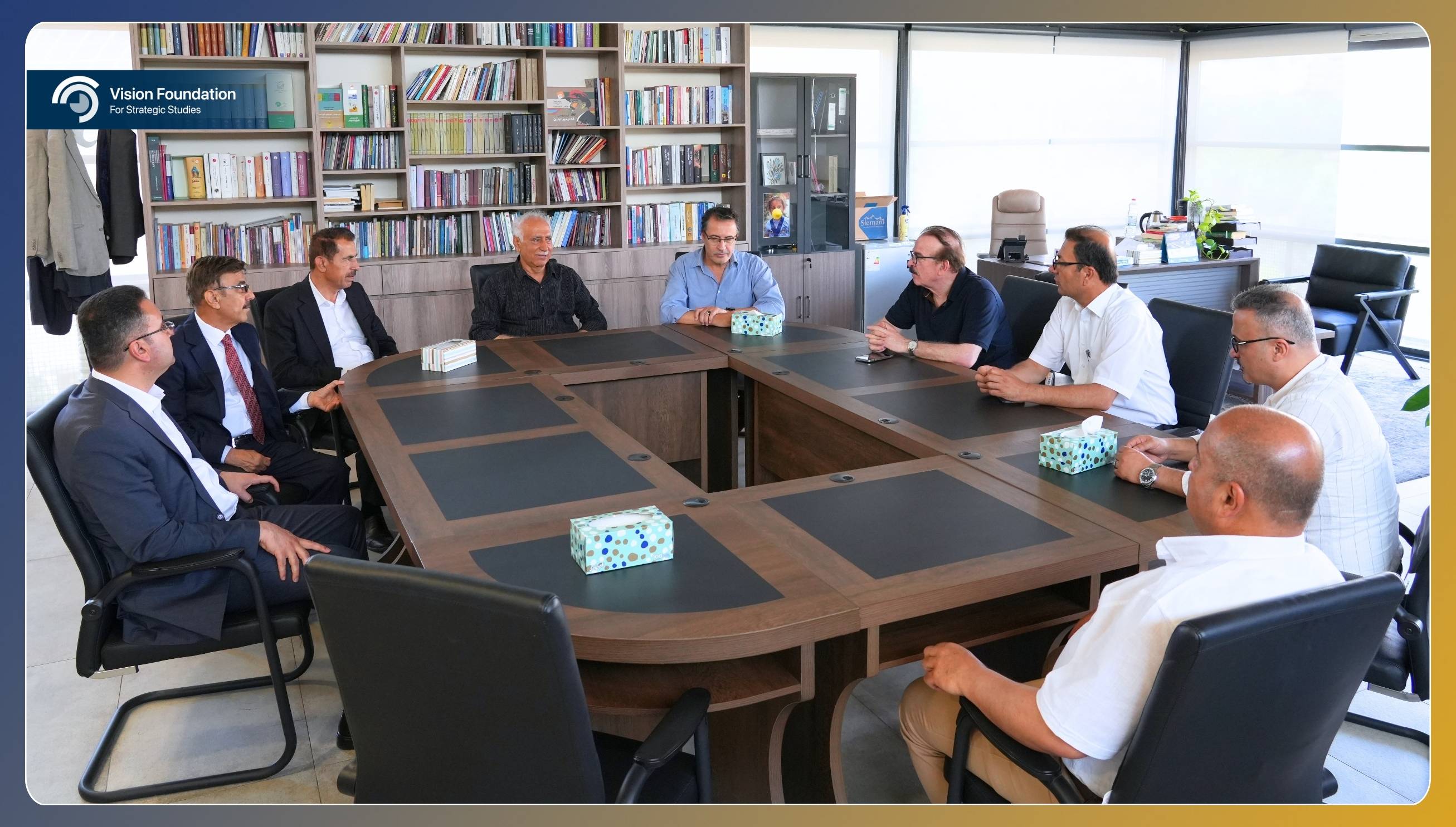
During the preceding period, the Vision Foundation for Strategic Studies organized two discussion panels on artistic work and theatre in Sulaymaniyah and the wider Kurdistan Region.
Artists, actors, theatre professionals and directors participating in those panels expressed serious concern about the current state of art and artistic production.
Among their main concerns was the negative role of security agencies and the manner in which they deal with artistic productions.
They said security institutions demand access to scripts for inspection or request to view films and television dramas before they are publicly screened.
Following their comments, artists may be forced to make changes, reshoot scenes or repeat parts of the production process. In some cases, the intervention may result in the suspension or complete prohibition of artistic works.
260727063443.jpg)
260727054831.jpg)
260722075704.jpg)
Share